Wednesday, October 9, 2013

How I lost my wifi and learnt to live without it (before it came back to me)

Toshiba Satellite U840_10V back-580-90

Image from www.techradar.com

Part 1: Shock and terror

The one year warranty on  my shiny, sleek and awesome Toshiba Ultrabook had just expired. Two days after that, I unplugged my laptop from the LAN cable in office and put it in ‘hibernate’ as usual. I came home and switched it on, hoping to connect to the wifi at home. But there was nothing. All it did was show me a LAN icon with a big red cross over it. I fiddled around a bit and did what all experienced techies do to computers to repair them – Shutdown and Restart. Nothing doing.

The wifi + Bluetooth flash card (F12 in my case) just stopped working. Pressing it elicited no response, although all the other flashcards for brightness, volume, touchpad etc. worked fine.

In addition to this, even the orange wifi light would not come on. Incredibly, even the wireless network adapters were missing from the device manager listing. This was getting more and more curious.

Part 2: Futile efforts

I tried re-installing the drivers from various sources so that now I have almost 14 different installation files for wifi adapters. Nothing worked. It was time to call for help.

I called up the Toshiba - India online service center tech guys. Over two days, 12 hours and way too much ‘music on hold’,  I spoke to 5 different people who all suggested five different things, most of which I had already tried. Nothing worked. Finally, the sixth tech guy on the phone threw his hands up and played an ace! He told me that I have a hardware problem and that I should bring it to the service center. This did not sound good at all. I cursed my luck and marveled at the fact that barely two days after my warranty expired, I would now have to visit the service center. This meant not just backing up all my data and getting ready for a reformat, but also a bill that would have me living on peanuts for the next few months. There was no way I was going to go to the service center, and there was no way this could be a hardware problem (In spite of my brother’s insane theory that something inside must have been affected by the large magnets in the massive woofer speaker on my work table!!)

Part 3: The miracle

All this time, the internet was working fine with a LAN cable. It was only the wifi and BT that was missing. I had deadlines to meet and decided to postpone the reinstallation by a week during which I tried to get a complete backup and finish my work. In between, there were two huge system updates. I missed my wifi, having to lug around the laptop and wrestle with those stiff unyielding LAN cables that limited my freedom. Atleast I was getting some work done I thought. It could be worse.

And then, the miracle happened.

Just the way it had left, one fine day the wifi and bluetooth just started working!! Everything was fine. It was almost as if nothing had happened at all and all this was a dream. I wasn't complaining, but I felt angry and relieved at the same time - angry at the incompetence of the tech guys on call trying to push me into the 'service center trap' while relief that I did not have to spend a single penny to repair something that repaired by itself!

Honestly, the only thing that I can think of is probably those system updates, one of which was massive. It must have been that. So, I guess, my advice to people with a similar problem is that if you have the option, then do wait and try and get the latest system updates, as installing specific driver updates doesn't always seem to work!

Friday, May 1, 2009

Acer Perspire One!

Modern technology

Owes ecology

An apology.

-- Alan M. Eddison---

In light of recent developments with my Acer Aspire One, I think modern technology owes a bit more than an apology to ecology and ecologists like me. To state that I’ve been having problems with my mini laptop (apparently they are called ‘netbooks’) would be like saying that nuclear weapons can kill people.

For the last month, I’ve been walking around in a daze trying to figure out how a three month old laptop can go from hero to villain with speeds that belie its 1Gig RAM. What makes matters worse is that I had recommended it to half a dozen ecologist friends of mine who immediately went ahead and bought it. This post is not just a rant, it’s also a warning to all those who are planning to buy the Aspire One about the potential problems. And I’m not going to give you the regular review shit about how the screen is small, resolution is less and keyboard is cramped.

After purchasing it in December, I was feeling pretty good about its light weight and extreme portability. I was able to carry it around wherever I went in a small backpack and seemed ideal for the life of a travelling ecologist. In the middle of a survey for slow loris in the state of Meghalaya in northeast India I would constantly congratulate myself on the money well spent. I was feeling too smug and I should have seen the writing on the wall right then.

The first signs of trouble started in the most unlikeliest of places. Cherrapunji. It has to be one of the most scenic and pleasant places in India. It’s the kind of place where you don’t really expect anything to go wrong, least of all the lean, mean light machine in your backpack. On the 12th of March it just stopped working. Rebooting was of no use. The screen was dead and although the indicator LED’s came on, the computer display for all practical purposes was dead. 

A few days later I was back in Shillong and frantically searching the Acer forums and discussion groups on the net for a clue. Many people reported it and there didn’t seem to be any solution. The discussion threads died without a satisfactory answer. The only Acer service centre happened to be in Guwahati, a hot dusty hellhole that some people call the gateway to northeast India. Personally I think there couldn’t be a worse advertisement for the northeast than Guwahati. However, that was where I was headed. 

On a hunch, I called up my friend Vivek in Bangalore, the only person to have bought this computer before me. And sure enough, I hit the jackpot. The same thing had happened to him a few weeks back! So what was the solution? Apparently all it needed was a BIOS update which any service centre would be able to provide in 10 minutes. Could it really be that simple? So why hadn’t all these jokers on the forums never said anything about it? This was an important lesson. Never believe all you read in the forums, or rather don’t expect them to solve your problems always. I decided to keep this nugget of information to myself and see what the service centre guys would come up with. As expected, the lone service guy slowly moved his right hand up to scratch his head in the classic sign of “ I don’t have a clue”. I decided I had proved my point and didn’t fancy having to spend the night in Guwahati. I gave him my BIOS update trump card. It was like a bulb went on somewhere inside his head. “Oh!”. It took exactly ten minutes just like Vivek had promised and the comp was up and running. 

“Phew! Close shave!” I kept repeating on the bus back to cool Shillong. Little did I know..

A few weeks passed. Meanwhile all the photographs and data from the survey had been transferred to the computer. I should also mention that I had meanwhile committed the most basic mistake of all computer users. I hadn’t partitioned my hard disk and was relying on pure luck to see me through whatever challenges (read crashes) that technology had in store for me. In the euphoria of having come out through a near death experience (not mine, the computer) I began to feel it was indestructible.

And then came 10th April. The survey in Meghalaya had just ended. I was sitting in Shillong with two colleagues at the forest rest house. The computer was playing some music when a particularly good song came along in the playlist. Now most people who have seen this computer would know that the speakers are next to useless because of their tiny size and tinny noise. Yet the public demanded a higher volume. I turned it up to the maximum volume and went out. Five minutes later when I came back the computer was dead again.

That was the start of another hellish journey. No matter what we did it refused to start up and would continue to reboot just as it reached the windows ‘loading’ screen. No amount of F8’s, ‘last known configuration’  ‘safe mode’ or ‘DOS mode’ helped. It just would not start.

So, it was back to Guwahati again. This time even Vivek didn’t have an answer. There was no time to check the internet. Pulse and heartbeats were rising fast. I just had to get to the rundown service centre first. 

The service centre guy like all service centre guys had one answer to all computer solutions. Reinstall Windows. Of course, he didn’t have a clue what had happened in the first case. I had all my survey data in there and there was no way I was going to let him obliterate any slim chances I had of recovering that. I spent five hours with him trying to persuade him to retrieve the data. In all fairness, he tried whatever he could (which wasn’t much). Then came the deciding moment. What was to be done? I decided I was going to take my chances and asked him to leave it alone. I wanted to get back to Bangalore (the ‘IT city’) and hopefully find someone more competent. I still couldn’t believe that two and half months of hard work would go poof just like that.

It was then that I started searching the net for information on such problems. Apparently in the last one month many people all over the world had the same problem with this computer and nobody had a clue why. All of them had had to reformat their disks and have everything reinstalled. Then came the crazy explanations. Apparently the Aspire One crashes if you play U2’s “Hold me thrill me kiss me” loudly claimed some people. Some said, not just that, other U2 songs too. Then someone else discovered even other songs by other artists (not necessarily non Irish) could bring it on. It was funny for the guys on the forum, while for me it was a life-and-death thing. Some techie guys suggested this intriguing possibility – computer body too small, right speaker too close to hard disk, loud volume creates vibrations and magnetic field disturbances. Hence hard disk crashes!! (read story here) 

This seemed like one cruel unending joke.

Finally I decided to hand the computer over to Karthik, colleague and friend who was on his way to Bangalore the next day. Then what followed were tense phone conversations as Karthik investigated all the so-called ‘hardware data retrievers’ some of whom apparently specialised in ‘disaster recovery’. Under normal circumstances I would have found these terms enough fodder for some famous jokes and put-downs. I really don’t think much of hardware guys. As if to justify my faith in them, two guys who tried their stuff on the computer surrendered with their hands in the air. The third guy was smarter. He claimed he could do it for 2,500 bucks. That reminded me why I hated them.   

The situation seemed pretty hopeless now. I was still not in Bangalore and there was no point in harassing poor Karthik anymore. I told him to ditch the search and sit back till I got there. One day later I get up in the morning to see a missed call from Karthik at 1245 in the morning. I call him back and he gives me those four wonderful words “Hey, I did it”. He did it! What he had done in a brainwave was to load the open source Operating System Ubuntu from an external drive and managed to get the computer running. Once in, he could see all the stuff I wanted and simply copied them onto another external drive. I was so happy and relieved; I had no idea what to say.

I know it’s going to be tough to get anything out of Acer for all the harassment I had to go through for no fault of mine, but I want to make sure all of the Acer Aspire One users read this and take note. Serious shit could happen and you’d better be ready. If you’re stuck with an Aspire One, preparedness should be second nature and backup should be your middle name.    


Sunday, February 1, 2009

The ebu gogo of Flores - an unfinished story

The locals knew of them as the ebu gogo, the 'grandmother who eats everything'. At first glance, it appeared to be one of those countless cryptozoological stories of mythical animals. "Probably a large macaque that was mistaken as a human" said the scientists.
In 1998 a team led by Michael Morwood of the University of New England in Armidale, Australia discovered crude stone implements and then followed it up by discovering LB1 (alternatively known as Flo, Hobbit etc.) the skeletal remains in the Liang Bua (LB) limestone caves of the remote island of Flores (see map and picture below) in the Indonesian archipelago. Subsequently, that cave revealed the existence of the skeletons of seven more of these 'hobbits', named because of their exceptionally small body size and height (see pic below).


It was one of the most electrifying findings in anthropology and started one of the most fiercely contested scientific debates over the origins of the little people of Flores. The owner of the bones seemed to have existed as recently as 12,000 years ago, something unimaginable for a primitive hominin, all of which were believed to have been extinct at least 24,000 years back.
One of the greatest mysteries of the modern world finally seems to be showing signs of resolution with the publication of the most recent study by Karen Baab and her colleagues at the Stony Brook University in the Journal of Human Evolution (Jan, 2009). The study addresses the primary bone (couldn’t resist the pun!) of contention among the two camps of scientists and concurs with the initial paper of Morwood which assigns the hobbits the status of a new species altogether - the Homo floresiensis. The opposing camp has vehemently protested this species status claiming that the skeletons were nothing more than pygmy Homo sapiens with microcephaly. What is of interest is the number of scientific papers in respected scientific journals that have gone back and forth proving and disproving the acceptance of this new species. And it hasn't been short of controversies too!
Looking at the immense volume of scientific literature starting from 2004, I have tried to simplify matters by summarising the findings for each year subsequent to the initial announcement of the find in Nature. The studies are colour coded green (agreeing with the hobbit being a new species) and orange (disagreeing on the species status):


2004
Brown, P.; Sutikna, T., Morwood, M. J., Soejono, R. P., Jatmiko, Wayhu Saptomo, E. & Rokus Awe Due . "A new small-bodied hominin from the Late Pleistocene of Flores, Indonesia". Nature 431: 1055

Morwood, M. J.; Soejono, R. P., Roberts, R. G., Sutikna, T., Turney, C. S. M., Westaway, K. E., Rink, W. J., Zhao, J.- X., van den Bergh, G. D., Rokus Awe Due, Hobbs, D. R., Moore, M. W., Bird, M. I. & Fifield, L. K. "Archaeology and age of a new hominin from Flores in eastern Indonesia".
Nature 431: 1087–1091.

Letter to Sunday Mail from M. Henneberg of the University of Adelaide, Australia on October 31st, three days after Nature report attributing the reduced head size to microcephaly

2005"Technical Comments: Comment on "The Brain of LB1, Homo floresiensis"". Science. 2005-10-14

Morwood, M. J.; Brown, P., Jatmiko, Sutikna, T., Wahyu Saptomo, E., Westaway, K. E., Rokus Awe Due, Roberts, R. G., Maeda, T., Wasisto, S. & Djubiantono, T. (2005-10-13). "Further evidence for small-bodied hominins from the Late Pleistocene of Flores, Indonesia".
Nature 437: 1012–1017

Falk, D.; Hildebolt, C., Smith, K., Morwood, M. J., Sutikna, T., Brown, P., Jatmiko, Wayhu Saptomo, E., Brunsden, B. & Prior, F. (
2005). "The Brain of LB1, Homo floresiensis". Science 308 (5719): 242.

2005 was an important year. The first scientific publication challenging Morwood's findings appeared in the form of the technical comments in Science. Till then it was restricted to letters in newspapers and articles in magazines. Dean Falk published her comprehensive study supporting the species status based on a brain pan. It was also the year when the controversy turned ugly with the shenanigans of Teuku Jacob of the Gadja Mada University in Yogyakarta, Java. Jacob was not in the team that made the initial discovery in Liang Bua. However, even before he published scientifically, he was already parroting the 'microcephaly' idea of Henneberg. November, 2004 Jacob had all the delicate skeletal specimens moved from the Indonesian Centre for Archaeology to his own laboratory without the permission of the Centre's Directors. He eventually had to return them after an outcry from other scientists, who knew of his reputation for restricting scientific access to fossils. But by then, the damage was done. Portions of the skeletons were severely damaged with two leg bones completely missing.

2006
Jacob, T.; Indriati, E., Soejono, R. P., Hsu, K., Frayer, D. W., Eckhardt, R. B., Kuperavage, A. J., Thorne, A. & Henneberg, M. (September 5, 2006). "Pygmoid Australomelanesian Homo sapiens skeletal remains from Liang Bua, Flores: Population affinities and pathological abnormalities". Proceedings of the National Academy of Sciences, USA 103: 13421–13426

Martin, R. D.; MacLarnon, A. M., Phillips, J. L., Dussubieux, L., Williams, P. R. & Dobyns, W. B. (
May 19, 2006). "Comment on "The Brain of LB1, Homo floresiensis"". Science 312 (5776): 999

Falk, D.; Hildebolt, C., Smith, K., Morwood, M.J., Sutikna, T., Jatmiko, Wayhu Saptomo, E., Brunsden, B. & Prior, F. (2006). "Response to Comment on "The Brain of LB1, Homo floresiensis"".
Science 312: 999c.

Argue, D.; Donlon, D., Groves, C. & Wright, R. (October 2006). "Homo floresiensis: Microcephalic, pygmoid, Australopithecus, or Homo?". Journal of Human Evolution 51: 360–374.


Dean Falk's paper continued to generate debate in the form of 'comments' and 'response to comments' from both camps. Jacob finally published along with various scientists from Australia and United States who attributed virtually everything in the skeletons to 'pathological abnormalities'. Debbie Argue compared the skull of LB1 to various microcephalic skulls and concluded that it indeed deserved the new species status.

2007
Falk, D.; Hildebolt, C.; Smith, K.; Morwood, M.J.; Sutikna, T.; Others, (2007). "Brain shape in human microcephalics and Homo floresiensis". Proceedings of the National Academy of Sciences 104 (7): 2513

Tocheri, M.W.; Orr, C.M.; Larson, S.G.; Sutikna, T.; Others, (2007). "The Primitive Wrist of Homo floresiensis and Its Implications for Hominin Evolution".
Science317 (5845): 1743.

Larson SG, Jungers WL, Morwood MJ, et al (2007). "Homo floresiensis and the evolution of the hominin shoulder". J. Hum. Evol. 53 (6): 718–31.

Hershkovitz I, Kornreich L, Laron Z (2007). "Comparative skeletal features between Homo floresiensis and patients with primary growth hormone insensitivity (Laron Syndrome)". Am. J. Phys. Anthropol. 134 (2): 198–208.

The important publications that added to the voices supporting the new species view were Tocheri et al. and Larson et al. Tocheri compared the wrist bones and concluded that it was very similar to African apes and early hominin-like wrist rather than modern humans and Neanderthals. Larson et al. found similar results for the shoulder bones. This proved that the hobbits were much more likely to be a new species rather than deformed modern humans.

2008
Lyras GA, Dermitzakis DM, Van Der Geer AAE, Van der Geer SB, De Vos J. 2008. The origin of Homo floresiensis and its relation to evolutionary processes under isolation. Anthropological Science. Published online 1 August 2008.
Hershkovitz I, Kornreich L, Laron Z (2007). "Comparative skeletal features between Homo floresiensis and patients with primary growth hormone insensitivity (Laron Syndrome)". Am. J. Phys. Anthropol. 134 (2): 198–208.

Obendorf, P.J.; Oxnard, C.E.; Kefford , C.E. (June 7, 2008). "
Are the small human-like fossils found on Flores human endemic cretins?". Proceedings of the Royal Society of London, B Biological Sciences (Online: Royal Society) 275 (1640): 1287-1296.

Lyras study confirmed what Debbie Argue had found by comparing the 3D-morphometrics of a number of microcephalic human skulls with the LB1 skulls. The LB1 skull morphometry was significantly different from microcephalic human skulls. Hershkowitz suggested that the hobbits were in fact afflicted by a hormonal disease called the Laron Syndrome. Similarly, Obendorf et al. proposed that the hobbits were actually born without a functional thyroid, leading to something called 'Cretinism' (and all this time I thought cretin was a swear word!). However the latter two theories didn’t seem to have too many takers.

2009
Baab, K and K. P. McNulty (2009). Size, shape, and asymmetry in fossil hominins: The status of the LB1 cranium based on 3D morphometric analyses. Journal of Human Evolution.
The latest in the series, this paper by Karen Baab looks at 3D morphometrics of the LB1 skull in much the same way as Lyras and Argue. Dr. Baab and colleagues collected 3D landmark data on the LB1 skull and a large sample of fossils representing other extinct hominin species, as well as a comparative sample of modern humans and apes. They performed several analyses of different regions of the skulls. Taken together, these analyses indicated that the LB1 skull shape is that of a scaled down Homo fossil and not a scaled down modern human.
So, is this finally the end? That’s anybody's guess, but as Karen Baab herself remarks, she recognizes that the controversy as to the evolutionary origins of Homo floresiensis will continue, perhaps without an answer.

Updated: 18/08/2014

Was that last paragraph above prophetic or not? So now, after all this time, it seems like the Flores human is not a new species at all. It was just the microcephalic skull of an individual with Downs Syndrome! If you look at my review above, there have been researchers who have come to similar conclusions earlier. How could a peer reviewed paper that announces something as dramatic as a new species of Homo fall so flat? Serious questions need to be raised on the review process for a start.
For the time being, here are some links to the popular articles on the new discoveries as well as the original paper:
http://www.sciencedaily.com/releases/2014/08/140804151510.htm
http://phys.org/news/2014-08-flores-bones-features-syndrome-hobbit.html
http://www.pnas.org/content/early/2014/07/31/1407382111.abstract?sid=b742aa82-5bcd-46cd-a8a3-59b72dec61b2

Monday, January 26, 2009

Worst jobs in science - almost there!


Popular Science magazine did a highly imaginative story recently  on the so-called 'worst jobs in science'. I thought it was a pretty interesting choice of the ten different  and varied jobs, guaranteeing a huge variety of physical and mental discomfort. I must say I was very impressed to know that I pretty much made the list in three different categories. Here they are : Triage Biologist, Monkey sex observer (I swear I'm not making this up!) and Leech researcher.

Personally I think the whole concept of a triage biologist (someone who chooses one species to conserve over another) has very little basis in logic. Supposedly mooted recently by Stanford University biologist Terry Root, who has worked with the IPCC, it wont win too many admirers among passionate conservationists. It is in fact more of an economist's way of looking at the

 threats to biodiversity on Earth.  The most basic problem is that we still don’t have the knowledge or the competence to start prioritising species based on their exact roles in the multitude of complicated ecosystems. Hell, we still haven't even a clue about the number of different species that exist on this planet and still talk of picking and choosing species we want to keep alive while the rest are to be obliterated off the face of time forever!!

Number two - monkey sex observer! Oh I've done my share of that with macaques. The reason why I don’t qualify is that unlike some primatologists, I wasn’t watching ONLY for the alpha male's thrusts and orgasmic grimaces. Its hardly as 'yuck' as the article makes it out to be. 

Number three - Leech researcher. If you a re a biologist and you work anywhere in the Western Ghats or northeast India, it doesn’t matter what researcher you are, the leeches are gonna get you anyway. Yeah, the slimy buggers are everywhere, black, yellow, green, striped, big small, medium, massive, itch inducing, sore inducing, you name it, they are everywhere. Umm.. yes, I didn’t have to be a leech researcher to gather the bloody evidence!

Just in case you're wondering about the other seven jobs, here they are:

Theoretical Physicist

Vermin Handler

Lone Fossil Ranger

Hurricane Hunter

Medical Waste Burner

Experimental Taphonomist

Mars Simulator Crew

Sunday, October 19, 2008

Capricious hair and disappearing Yetis - how the Goral lost its range!

So, the Yeti (mande burung) hair turned out to be from a goat. Everyone knows that by now. Just a case of false alarm, huh? It was just a dear old Goral (Nemorhaedus goral) who was having a bad hair day. Dipu Marak got his five minutes of fame, the officials of the Meghalaya Forest Department are heaving a sigh of relief and the media circus will move on elsewhere for fresh meat (during the peak of the circus, some Hindi news channels even proclaimed that people in Meghalaya were so terrified of the mande burung that nobody dares venture out of their homes after nightfall!). Okkay so is everybody accounted for? Umm.. not quite… There is a certain Ian Redmond, the 'ape expert' who was heading the investigation of the hairs.

This is what he had to say :

"Nevertheless, the DNA test is an interesting result because the reported location where this sample was collected is way south of the published distribution maps of the Goral species, which is said to live between 1,000 to 4,000 metres up in the Himalayas.

Perhaps we have a more modest discovery - extending the known range of the goral rather than confirming the existence of the lowland yeti,"

Sorry Ian, but that is complete nonsense. There is published scientific information on the fauna of this region and it clearly states that the Brown Goral (Nemorhaedus goral hodgsoni), one of the three subspecies of the Himalayan Goral is found in Meghalaya. Among others, one publication by the Wildlife Institute of India, my former institute is even available on the net. It is locally known as chon.gipa matrong. I have sighted it myself and just a couple of weeks back one was killed near a village by some hunters.

So where DID Ian get his 'known range'? Unfortunately, the figure of 1,000 - 4,000 metres appears to have been lifted verbatim off some mammal encyclopaedia or some such ready-reference guide. One such guide is the Grzimek series on world fauna. The section on Bovids which contains information on the Himalayan Goral provides the same figure. These are excellent books, but unfortunately the information in them is frequently outdated. The maps are even worse, and the so-called 'distribution range' diagrams (see picture below) are nothing more than artistic squiggles based on pure conjecture. On the other hand, the maps produced by the Wildlife Institute of India is mostly based on actual field research, making them relatively more accurate. Even the Meghalaya Forest Department has produced management plans for the two protected areas in question - Nokrek and Balpakram which record the Goral among the fauna.

Can you possibly believe that a senior scientist investigating Indo-Malayan fauna would not conduct an exhaustive search for scientific literature, but rather depend on some 'big name' generalized account? It defies logic when such statements are made and even reported by the BBC.

I would like to believe that he was just plain lazy and never bothered searching, because if he did find them and discarded them, that would establish a common but unfortunate phenomenon - scientific racism. It happens all the time, ask any scientist from the third world and they will tell you how it shows up regularly in the form of missing references to key papers.

A last point. Note how Ian refers to the 'lowland yeti'. So, we can safely assume he has already analysed the hairs of the 'highland yeti'. And mapped its 'known range'. Wonder what goat that is !!

------------------------------------

Links:

Wildlife Institute of India

Mande burung, the Indian Bigfoot

Wednesday, September 3, 2008

Ballet dancing flies and the freedom of scientific research


DISCOVER magazine is one of the best reads on the latest happenings in the world of science and technology. There are always a range of interesting articles on their website. Here’s a recent headline: ‘Researchers crack the case of why flies are so hard to swat’. The story went on to describe how a recent scientific paper in Current Biology by biologist Michael Dickinson found the reasons why swatting flies was so difficult (with the help of high speed video photography). Apparently, the flies performed ‘an elegant little ballet with their legs’ before positioning their centre of mass above their two middle legs which are used to jump away from the direction of the threat - read, your swatter! Oh yes, they do all this within 100 milliseconds, which would be considerably faster than the movement of your fly swatter. Michael Dickinson has more to say. Trying to be helpful, he suggests ways to literally ‘beat’ the fly and increase your chances of swatting it into pulp. He suggests that the ‘right way’ to swat a fly is not to aim AT them, because they are extremely good at anticipating where your blow will land (and presumably do their shuffle dance before pushing away). No, the way to successfully swatting a fly is to aim slightly ahead of the fly’s starting position, so that its you doing the anticipation, not the pesky Dipteran. So, there it was.. Another victory for humans and one less mystery in the world. Is that it? Ermm.. Not quite.
When this article was posted on the DISCOVER website, the first comment submitted on this story by readers was by someone called Jackie. Here it is, word for word, caps for caps..
“I AM TRULY PLEASED THAT WE LIVE IN A WORLD WHERE KIDS ARE GOING HUNGRY, GAS IS 50.00 A GALLON, AND OUR SOLDIERS ARE DYING FOR NO REASON (THEY’RE NOT PROTECTING MY FREEDOM, THEY’RE CLEANING UP IRAQ’S MESS ON MY DIME) AND SCIENTISTS ARE GETTING GRANTS FOR THIS CRAP. I AM A BETTER PERSON, NOW, FOR KNOWING WHY A FLY IS SMARTER AND MORE SPRY THAN I. THANK YOU.”
Jackie was apparently, not having a great day and decided to take it out on the helpful Dr. Dickinson. But really, what followed after that comment of hers was unique. When I last checked, there were fifteen comments after that and 12 of those ripped Jackie apart for disregarding the scientific and evolutionary importance of this discovery and confusing scientific research fund allocation with rising costs of living and US foreign policy. The message seemed to be - leave the scientists alone!
But, Jackie is not an isolated phenomenon. I have lost count of the people who have expressed displeasure at the so-called ‘useless research’ of scientists, especially that in the field of biological sciences. In India, we even have heads of state lecturing research institutions to pursue more of ‘applied research’. Having started my career as a biologist with behavioural research on wild primates, I know how difficult it was to make people understand the significance of concepts such as cognition, theory of mind, deception, and the evolution of intelligence in primates. The general response would be on the lines of “ What? Is that ALL you do? Watch monkeys all day? And you get paid for this?!”. This was the cue for me to produce one of my earnest smiles and attempt to launch into an explanation of the importance of understanding our ancestors behaviour to gain a better understanding of the complexities of how humans evolved to become the most intelligent species on this planet. And the most petulant. But, they were long gone.

Wednesday, July 30, 2008

Meghalaya’s Yeti: The mande burung – the inside story from a wildlife biologist in Meghalaya


If you still haven’t heard of the media frenzy over the recent ‘discovery’ of the ‘Indian Yeti’ or the ‘cousin of Bigfoot’ in the Garo Hills of Meghalaya, just read on because I KNOW what I’m talking about. And if you are one of those few who don’t know what or who Bigfoot and the Yeti are.. well.. then I guess you can just stop reading and move on to whatever the hell you were doing !

The internet has been abuzz in the last few weeks with stories of an ‘ape-like creature’ in the mountains of the Garo Hills of Meghalaya. Stories of the repeated sightings, kidnapping of humans, fossilised footprints, nest building and even video clips kept doing the rounds. Much of these stories started after an adventurous BBC reporter, Alastair Lawson landed up in Tura in the West Garo Hills and filed this story . Before you could say ‘scientific enquiry’, the paranormal addicts were out and the blogs and websites were having a field day. How am I any different you ask? Okay, fine since you ask.. I live in the Garo Hills and am a wildlife biologist by profession. Its my job to know this stuff !!
The
latest news on this is that during his trip to the Garo Hills, Mr. Lawson was handed over a few strands of hair allegedly belonging to the mande burung. The hair was taken to the UK (probably in contravention of the Wildlife Protection Act and the Biodiversity Act!) and an initial visual inspection of hair structure was done with microscopes which proved inconclusive and could not identify which animal the hair came from. This isn’t surprising as positive identification of hair source based only on microscopy is not possible for many species, especially not by somebody in the UK unfamiliar with Indo Malayan fauna! Now, they say, the hair samples are being sent to the Oxford Brookes University for DNA extraction and fingerprinting. That should be able to identify the general taxonomic category of the owner of those strands if such an animal does not exist. If not, we’ll know soon enough. So its make or break time!

Now, first the basics… Reports of hominoid cryptids (slang for cryptozoological animal, cryptozoology itself means the study of mythical or legendary animals whose existence is disputed or unsubstantiated such as the Yeti and the Lochness monster) are not new. They have been reported from each and every continent (except maybe Antarctica). The Yeti and the Bigfoot are just two of the most famous ones, the former because of Sir Edmund Hillary’s claim to have seen footprints in the snow on the way to Mt. Everest and the latter … well just because its American!!
In reality similar creatures have been reported with great accuracy and frequency especially from parts of China and all of southeast Asia (example Yeren of China, Nguoi Rung of Vietnam, Bir Sindic of Myanmar, Hantu sakai of Malaysia and many more). Northeastern India (where the Garo Hills is present) lying next to southeast Asia shares enormous ethnic, cultural and ecological similarities. Together, they also comprise the Indo Malayan biodiversity hotspot. Is it any surprise then, that stories of such creatures are common here?

Okay so what about this creature? First, lets get the orthography right because BBC and Mr Lawson really screwed up on that. In the Garo language the creature is called mande (man) burung/buring (forest) which is self explanatory and not mande barung as reported by the BBC. Locals have always known about this creature, a 3m tall and 300 kilograms black and grey ape-like animal. The sudden renewal of interest seems to have been the handiwork of the Achik Tourism Society, an organisation run by a few hardcore believers.
Or maybe it isn’t that simple.
You have to admit they are creating the perfect advertising campaign to attract the Yeti, Sasquatch and Bigfoot crowd to remote Garo Hills. Money does talk Mr. Dipu Marak, doesn’t it?

Oh, you’re still reading. That proves you have an open mind and are willing to believe (albeit with a pinch of salt) the testimony of local eyewitnesses.
Here
is a sample. Well if you discount some of the really crazy stories like a man being kidnapped by a female mande burung, being kept in a nest for three days and being forcibly suckled with “bitter and sour tasting milk”, most of the other stories have a great deal of uniformity at least in the description of the creature. The region where it is reported from, the Nokrek Biosphere Reserve and the Balpakram National Park are both truly remote areas. Steep and rocky mountains, gorges, thick tropical jungles and vast network of underground caves formed because of the limestone deposits make it unusually difficult to traverse. I haven’t seen tougher terrain anywhere else in the northeast. It’s not easy to completely discount the existence of an unknown animal in such surroundings.

Mistaking animals for such creatures are not uncommon and have happened before. In many cases it has turned out to be a bear. The footprints of a bear too are eerily similar to that of human or hominid footprints. In this area of the Garo Hills, the two species of bears that are found are the Asiatic Black Bear (
Ursus thibetanus) and the Malayan Sun Bear (Helarctos malayanus). Of them, the former is larger and could be mistaken for a creature of this sort.

There is however an even more intriguing possibility. It could be one of the last surviving members of the prehistoric giant ape Gigantopithecus blackii, remains of which were found in China and Vietnam and is thought to have been geographically distributed across southeast Asia. There are other ancient hominids of the same nature which were thought to have roamed across southeast Asia and India not very long back. They are Meganthropus palaeojavanicus and Pithecanthropus erectus (later known as Homo erectus, the Java Man). Pithecanthropus was announced in 1894 and was initially thought to be the ‘missing link’. Either way, this isn’t the end of the story. And something tells me even if the DNA tests show that those strands of hair belong to a bear or a serow, some people will still keep searching. I am one of them.
Links:

Wednesday, July 9, 2008

Finding Maraland

My recent article in Himal Southasian Magazine (June, 2008 issue) about my experiences of surveying and discovering one of the most remote corners of northeast India. I wish I could write an 'unofficial' version of some of my experiences during this time too. I doubt much of that would get published anywhere :)
For photographs related to this area, do visit my FlickR album. There is a link on this page:

Finding Maraland

Few wildlife biologists have treaded the paths of southern Mizoram's lush forests – and those who do, emerge rooting for the people.

By : Anirban Datta-Roy

A baby cried, an old man coughed with tuberculosis-infected lungs, and two young men and a girl crooned an old Mara song. A Burmese cheroot was lit, and passed it to anyone who showed any enthusiasm for smoking this vile imitation of a cigar. Suddenly, the vehicle we were all travelling in skidded, the tires spinning and splattering us with mud. We were stuck again.

Still, things seemed perfectly normal in the early-morning chill. It was November 2006, and I was making my way back to the village of Phura, deep in southern Mizoram. The ride from the town of Saiha to Phura is a mere 98 kilometres, yet it was to take 14 hours in a battered Mahindra pickup, loaded with people and sacks of rice. During that time, our vehicle snaked along precipitous foot trails, which had been cut wider to serve as tenuous roads. The rice sacks were meant for the public distribution system, but for the moment they also served as seats for the 30 to 40 passengers at the back. Twelve of my co-passengers were friends from nearby villages, and the others I recognised by sight. They knew that I was here for the ramsa ('wild animal' in the Lushai language) survey, which was to document mammals and birds in the area.

A little more than a year earlier, my colleague Arpan and I had been sitting in the state capital Aizawl, trying to decide where to start a community-based conservation initiative. We could hardly have imagined that we would eventually reach Mara District, in the southernmost tip of Mizoram, a place that seemed surprisingly blank on the political map. It intrigued us that there still existed areas with such minimal human presence and vast forest cover. Even wildlife biologists had neglected this lush area, due simply to its remoteness.

Within a week we were in Saiha, the district headquarters, sitting in the house of Deputy Conservator of Forests Thaly T Azyu, of the Mara Autonomous District Council Forest Department. He told us that we could visit Palak Lake – pala tipa in the local Tlosai Mara tongue. The lake was close to the village of Phura, but going further south into those blank spaces on the map, we were told, would involve "a bit of walking". With that bit of advice, we set out.

Around Pala Tipa
Palak Lake, the largest lake in Mizoram, is a breathtaking sight, surrounded by mountainous jungles and jhum fields. The place abounds with birdlife. Common moorhen, darters, oriental pied hornbills, imperial pigeons,
trogons and garrulous laughing thrushes are all abundant in the area around the oval-shaped body of water. The lake itself measures about 400 by 600 metres, and has an almost crater-like appearance, with the lake's water level inside the rim higher than that of the surrounding ground.

To its east and southeast, the lake touches a lush patch of primary forest, which has retained much of its canes, palms and massive dipterocarp trees. A broad variety of mammals also continues to thrive here, in spite of the area's proximity to two major villages, Phura and Tokalo. (Not all mammals have done well, though. When we were there, a lone elephant was wandering the area – all that was left of the last herd in this area.) The only source of previous information for the Palak Lake area had come from Samrat Pawaar and Aysegul Birand's astounding 2001 survey of the Indian Northeast, which had documented some species of wildlife completely new to science.

From Palak, our guide Radia led us to our next stop, the village of Tokalo, after a steep and relentless climb of seven kilometres. As we trudged on, my backpack seemed to get heavier with each step. This was a sensation with which, like myself, visitors to this area have longed been forced to deal. Reverend Reginald Lorraine, the first missionary to visit Mizoram, back in the early 1900s, put it well when he said, "In this land, you can either go up or down."

Over the next 11 days, we forced our weary legs through all eight villages of the area. Wherever we went, a handshake and a chibai (a Lushai greeting) was all it took for people to welcome us into their houses, and give us food and shelter much beyond their meagre resources. As Arpan quizzed the village elders on their land-tenure rights, village-council dynamics, system of selecting jhum lands and cycles, I asked the hunters which animals could still be found in the immediate surroundings. With just a few photographs, a field guide and a very problematic translator at our disposal, it was a miracle that anyone could understand anyone else.

But the information that we found was exciting. I was thrilled to hear the locals reporting the presence of clouded leopards, wild dogs, Phayre's leaf monkeys and many other rare animals. Then there were the trophies, hanging near the entrance to virtually every house. These told of an amazing diversity of mammals, reptiles and birds. Skulls of wild pig, sambar, serow, barking deer, casques (the helmet-like craniums) of hornbills and squirrel tails decorated the entrances of many of the simple bamboo habitations.

However we looked at it, the signs were extremely encouraging. In spite of all the animal remains that we saw, active hunting of large mammals seemed an activity restricted mostly to the few professional hunters in the villages. While these hunters occasionally shared their catch with relatives, depending on the size of the animal, there was no sale and most of the meat was for self-consumption. Others hunted mostly in the vicinity of the villages, and most of the skulls that we had seen had been shot by farmers guarding their jhum crops. Commercial hunting had yet to enter the region, we concluded.
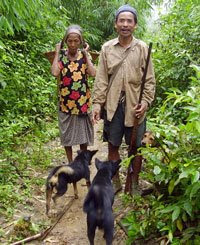
There were other encouraging signs in Maraland, as well. Each village had forest reserves for both 'supply' and 'safety' uses. These showed both foresight and appreciation for the importance of the forests in the lives of these communities. The supply reserve, a patch of forest that was utilised by the villagers for their daily needs, had a host of intricate rules to discourage overexploitation by a select few. The safety reserve, on the other hand, was akin to the sacred groves elsewhere in India – such as those in the Khasi hills nearby or the Kodagu District in the Nilgiris – only without the 'sacred' aspect. The safety reserve was absolutely out of bounds for any use during normal times, and there were severe penalties for people who broke the rules. Meanwhile, jhum cycles had remained at roughly six- to seven-year intervals, always outside of the forests, giving the forestlands sufficient time to replenish themselves.

There was no need to look any further. This was exactly the place we would set up our conservation project.

The survey
First we needed to confirm the presence of the animals being reported by the local people, through rigorous
field surveys. This was, of course, easier said than done. The steep mountains and persistent rains on the small, muddy roads made vehicles useless. This also meant that we would not have the luxury of staying in a village and travelling out to our survey locations.

These conditions essentially decided for us what we needed to do. We had to build a bamboo camp in the forest, carry our supplies there and then get on with the surveying. The survey itself would rely on our sightings, call detections and other indirect evidence of animal presence, such as droppings and tracks. We also had five infrared 'camera traps' to be set up in the forest, which would allow us to capture images of the elusive nocturnal fauna.

Days began early. The field team, consisting also of two forest guards and one field assistant, would start off after a cup of tea at dawn. We walked the various animal trails, streams and ridgelines, looking for animals and birds. Often, we would have to diverge from our predetermined route when we heard gibbon calls, in order to get to a ridge or peak from where we could catch a glimpse of these elusive yet vocal animals. When they were close, it was even possible to sneak up on them below the tree where they were causing the ruckus.

It was important to be alert at all times, though not only in the name of animal detection. Self-preservation was a constant worry in the rugged landscape. Often, the only way to come down the slopes of a hill would be, much like apes, to slide down the inclines while our arms held on to whatever trees or bamboo stems we could grasp. Inevitably, our days ended with cut hands and bruised legs, and extremely sore backsides.

Our visits to nearby villages for rice and other supplies also brought us closer to the local communities. There would always be an appreciative and interested audience to hear about our team's latest experience in the forest. Advice was never in short supply, ranging from helpful suggestions on areas that the survey team should visit, and tips on paths and trails we had not seen, to somewhat more personal proposals that hinted at me getting married and settling down in their village. Those fireside sessions, punctuated by the calls of tokkey geckos, would inevitably lead late into the night. Occasionally, the locals also voiced some concerns. Why are you doing this survey? What does it mean for us? Is it true that the whole area is going to become a sanctuary, and that we will all have to leave? At other times, they were preoccupied with the bamboo flowering, which had just started. What is the government going to do about that? What about when the rats come in swarms, and famine strikes?

It was apparent that communication was lacking between the state authorities and the villagers, as the former had already taken some measures to tackle the problem of the mautam, or bamboo flowering that takes place every half-century. In this remote corner, however, few had heard about these initiatives, and quite naturally feared the unknown. Their isolation also meant that people had long been deprived of various essential services, such as health care, schools and markets at which to sell their produce. This also included access to information regarding the various schemes that were available, including income-generation undertakings such as the National Rural Employment Guarantee Scheme, or rice-supply programmes such as the Public Distribution System.

Maraland development

Our survey came to an end after we returned twice more to the Palak Lake area. During this time, we set up two more field camps, discovered six more troops of Phayre's leaf monkeys, saw leopard tracks right outside our camp, braved an army of leeches, survived on crabs and soyameal for two weeks, and skinned, bruised and sprained more body parts than we cared to remember. We also managed to confirm the presence of 42 species of mammals, 136 species of birds and 40 species of butterflies. We also identified troops of the endangered hoolock gibbon.
It was a proud moment for us when we finally presented the survey results in the presence of the dignitaries and officers of the Mara District Council. It had the desired effect. Soon, hardnosed bureaucrats were reminiscing about animals and birds that they had seen in their own childhood villages. Suddenly, everybody was talking about wildlife and conservation. Of course, some were comparing the culinary merits of various types of monkey, but this was to be expected: attitudes do not transform overnight.

But things were already starting to change. Maraland's inherent seclusion had long been due to the simple lack of roads, but that is bound to be gradually whittled away. There is already talk about the dirt road between Kawlchaw and Phura being metalled. There are also periodic surges of enthusiasm within government agencies to 'develop' Palak Lake and its surrounding areas. But past actions in the name of development have been disastrous. During the 1980s, the Fisheries Department introduced the African cichlid fish and common carp into Palak Lake, resulting in the complete extinction of the original species, about which very little is known. Also during the 1980s, the Agriculture Department reclaimed the swamps surrounding the lake for wet paddy cultivation, which contributed greatly to the extinction of the area's elephant population. Today, it is only that solitary, forlorn, middle-aged elephant that survives.

Now, the Tourism Department is keen to make the site into a tourist attraction. The problem here is not development per se (inevitable as it is), but rather uninformed development schemes that are more harmful than helpful. If tourism is promoted as haphazardly as were the examples from 20 years ago, it will undoubtedly have a negative effect on Mara's ecological balance.

At the end of the day, despite our focus on wildlife, it was clearly the poor peasant, living in near-primitive conditions in remote villages, who needed immediate attention. It was not too difficult to see that conservation in these mountains would succeed only when we were able to provide these communities with basic services, and answer their lingering questions. This realisation should perhaps make us feel daunted, even intimidated. But, somehow, the warm winter sun and the cheerful lives of the Mara people ended up giving us hope that it is possible to strike that elusive balance between people and conservation.


Links:

Himal Southasian - www.himalmag.com

Samrakshan Trust - www.samrakshan.org

Thursday, March 20, 2008

Thank You, Sir Arthur

Photo Credit: Arthur C Clarke Foundation

The irony was inescapable. When I heard that Arthur C Clarke was no more on the radio, I had in my hand "Time's Eye" his 2004 novel.
There have been some brilliant science fiction writers but Arthur was one of those elite few who not only came up with ingenious ideas and plots, foretold the future through his stories, wrote really, really well but most importantly, got people interested in this unique genre of fiction.
I read "Rendezvous with Rama" when I was in my 11th class. Life was never the same. That one book got me hooked to science fiction, an interest that still lasts. That was when I discovered all the other masters - Douglas Adams, Robert Heinlein, Isaac Asimov, Philip K Dick, Ray Bradbury...
But I never forgot Arthur. His name would keep popping up in the news every few days for something that he had predicted 20 years ago would actually have been happening right then. Like his novel "The Hammer of God" about knocking off asteroids that stray too close to Earth (also the 'inspiration' behind the hit movie 'Aramageddon'). More well known is how Arthur wrote an article “Extra-Terrestrial Relays” for Wireless World in 1945. The article envisioned a communications satellite system that would relay radio and television signals throughout the world; this system finally came into operation two decades later. In his preface to the book 'Venus Prime' he refers to his story "Breaking Strain" which almost eerily predicted the near fatal experience of the Apollo 13 space shuttle in 1970. He writes "I still have
hanging up on my wall the first page of the mission summary, on which NASA Administrator Tom Paine has written: ‘‘Just as you always said it would be, Arthur.’’

One of his most famous collaborations, and probably the only time people who didn't read science fiction heard of him was the film adaptation of his 1951 story 'The Sentinel' into '2001: A Space Odyssey' with Stanley Kubrick. That film is still ranked among the list of 'top ten films ever made' by any reviewer.
He spent most of his later life in Colombo, Sri Lanka where he developed a great interest in the sea and later even campaigned for saving the mountain gorillas in Africa. On his 90th birthday, he expressed three wishes - for Extraterrestrials to contact us, for mankind to stop relying on oil and for peace in Sri Lanka. He also predicted that commercial space travel would become commonplace. Going by Arthur's track record, you can be sure thats exactly whats going to happen!

Thank you, Sir Arthur Charles Clark.

Monday, March 17, 2008

Connecting Earth


So you want to save the earth? But you just cant seem to get off Facebook and Orkut, huh? Well, in this age, there is a solution for everything. Welcome to the latest way to save the planet - connect2earth.org.
“Connect2earth is a truly global space for young people to connect, share, express their concerns and hopes about the environment online — and win some prizes in the process” .. so says James Leape, Director General of WWF International. WWF and IUCN tie up with Nokia to create this website which allows users to share pictures, videos and articles about the state of the planet.
Thats great. Whats also understandable is that having a corporate sponsor like Nokia, you cant escape the puns on the website "connect2 earth" in true sms style. The content and the material is visually appealing and the text is simple.
I am trying very hard not to be cynical, but when you are hit with these two huge ad banners on the homepage that proclaim "Save the planet. Win a phone" and "Upload now to start changing the world".. well then you start wondering.. if you really need to give a phone every month to get this generation of people interested in saving the planet... phew.. Good Luck!!

A regular guy?


I don't know how I missed this one. Recently came across the name of Martin Strel. He has been described as a 'marathon swimmer'. He's 52 and has swam .... now hold your breath... the Danube, the Mississippi, the Yangtze and last year the Amazon!! The mighty Amazon, of the piranhas and the bull sharks and 5,268 km., he swam in 66 days!!
He claims he's doing it to raise awareness of the need for conserving these magnificent sources of freshwater, most important to man. Well, he certainly did raise awareness. He's already come out with a book "The man who swam the Amazon" and apparently, a movie deal is in the offing with Hollywood. But of course!
Well here's what Martin himself had to say "I am a regular man, a regular common guy who just has higher goals than usual".
Yeah. Right!!


Martin Strel's diary when he was swimming the Amazon
Review of his book on Amazon.com


Tuesday, January 22, 2008

Vikings show the way


In an age when most of the first world plays the ostrich in the sand faster than the time it would take you to say "Kyoto Protocol", "Climate Change" or "Carbon Credits" and the 'tigers' and 'dragons' of the third world continue to provide encores as the innocent bystander, its heartening to see that good sense still prevails in some places. Guess who? Its Viking and Fjord country, Norway which seems to be leading the way in their own quiet way. Its time the rest of the planet dwelling in their fools paradise woke up to the truth that paradise is turning into hell.
Last year, Norway had pledged to go 'carbon neutral' by 2050 by cuting carbon dioxide emissions to nil. It was one of the most ambitious plans to offset cabon credits by any country. A couple of days back, a Labour led government in agreement with three of their opposition parties, decided to go one step further and drag the self imposed deadline down by 20 years to 2030.
And in case you still havent heard of the other big thing that the Vikings have been 'cooking up', there's the 'Noah's ark of seeds'. This sci-fi like project by the Norwegian government and the Global Crop Diversity Trust is located in the icy arctic, 600 miles from Norway in the archipelago. The Svelbard Global Seed Vault sits there 400 feet into a sandstone mountain with the vault's internal temperature being independent of the surrounding permafrost. Whats it for?


Its to safeguard all known crop species present on this planet in one place where it will be safe from all the wonderful things that we like to do to each other like nuclear war, floods and catastrophes from global warming, terrorist attacks. At 425 feet above sea level, protected by video surveillance and layers of metal doors, the three chambers inside are capable of holding 4.5 million samples of crop seeds.
The project also brings forth the question of 'agricultural biodiversity' which is almost as important as biodiversity of exotic plants and animals in faraway places. Artificial selection for high yielding varieties of crops make us vulnerable to losing the genetic variety of the lesser used wild strains. As we lose these strains to extinction, we lose the unknown benefits that those varieties could have provided us.
Its humbling to think that the apocalyptic future we read about in sci-fi books, may not be too far away.
There just seems to be one problem with the Svelbard Seed Vault, as a letter to New Scientist put it very crisply.. "Where are the keys?"

Original story of the seed vault on New Scientist

Tuesday, December 11, 2007

The Santa Cause

Just came across this ad spot for Greenpeace by an Australian ad agency. Maybe its poetic justice that I'm posting this on the day Al Gore and the IPCC chairman Rajendra Pachauri accept the Nobel Peace prize for their contribution to the awareness on global warming.
It does look like Santa's gonna have to buy a boat sometime soon.

Of carnivorous pitchers and viscoelastic deaths


"A Viscoelastic Deadly Fluid in Carnivorous Pitcher Plants"
Its not everyday that a scientific paper with a title like this gets published. But it did, recently on PLoS one, the free access online journal that publishes papers from all disciplines. So, what did Laurence Gaume (biologist) and Yoel Forterre (physicist), the French authors have to say?
That carnivorous pitcher plants can get pretty sticky when it comes to getting their one course meal. Okay that doesn't sound too impressive huh? Take this..
All this time we spent in school reading about pitcher plants (genus Nepenthes) capturing insects by their slippery surfaces and the enzymes inside that digest the insect slowly... well thats not all. As it turns out this digestive enzyme in some species (Nepenthes rafflesiana pictured above being the star of the show here) has viscoelastic properties.
Apparently, thats the physicist and his fluid dynamics jargon speaking here.
In plain speak, the fluid has both viscous and elastic properties that ensure that once the unfortunate bug gets anywhere in contact with the fluid its in a real sticky mess. The viscoelastic filaments in this fluid act like a quicksand, coating the insect and making it immobile the more it struggles. Meanwhile it gets digested. What a way to die!
Oh yeah, thats not all. This miracle fluid works perfectly well even after 90 percent dilution with water. Which figures, because these tropical plants see a lot of rain and if a little bit of water ruined your whole prey capture mechanism, then grandpa Natural Selection would have kicked you out long back.
Messieurs Gaume and Forterre apparently had a ball doing this study using insect bioassays (read killed different insects with the same stuff to see if they die the same), high speed photography and rheological analysis (thats the physics geek there again!).

The Indian pitcher plant Nepenthes khasiana (left)


Public Library of Science journals
Carnivorous plants on Wikipedia